
RV Hookups for Beginners: Water, Electric, and Sewer Made Simple
Introduction
RV Hookups for Beginners – For many new RVers, nothing feels quite as intimidating as these three hookups: water, electric, and sewer.
You can picture the open road. You can imagine the campground, the campfire, and the coffee outside in the morning. But then reality shows up in the form of hoses, power cords, sewer connections, breakers, adapters, valves, and that nagging little fear that if you do one thing wrong, something expensive or embarrassing is going to happen.
We understand that feeling.
Over the years, we have met countless RV beginners who were excited about traveling but nervous about the practical side of life at the campsite. And hookups are often at the top of the list. Water feels mysterious. Electric feels technical. Sewer feels, well, like something you really do not want to mess up.
The good news is this: RV hookups are not nearly as complicated as they seem at first.
Like so much in RVing, the fear usually comes from unfamiliarity, not actual difficulty. Once you understand what each connection does, what tools you need, and the order in which to do things, hookups become routine. In fact, after a few trips, you may barely think about them at all.
This guide is designed to take the stress out of the process and explain RV hookups in plain English. No jargon for the sake of jargon. No assuming you already know the basics. Just simple, practical help from people who have done this for years and still remember what it felt like at the beginning.
If you are new to RVing overall, our Complete Guide to the RV Lifestyle is the big-picture place to start. But if you are parked at a campsite, or thinking about that first trip and wondering how all this actually works, this article will help you make sense of water, electric, and sewer without feeling overwhelmed.
1. First, Take a Breath. RV Hookups Are Just Three Basic Systems
When you pull into a campground, it is easy to look at the pedestal, the spigot, and the sewer connection and feel like you are staring at a control panel from a spaceship.
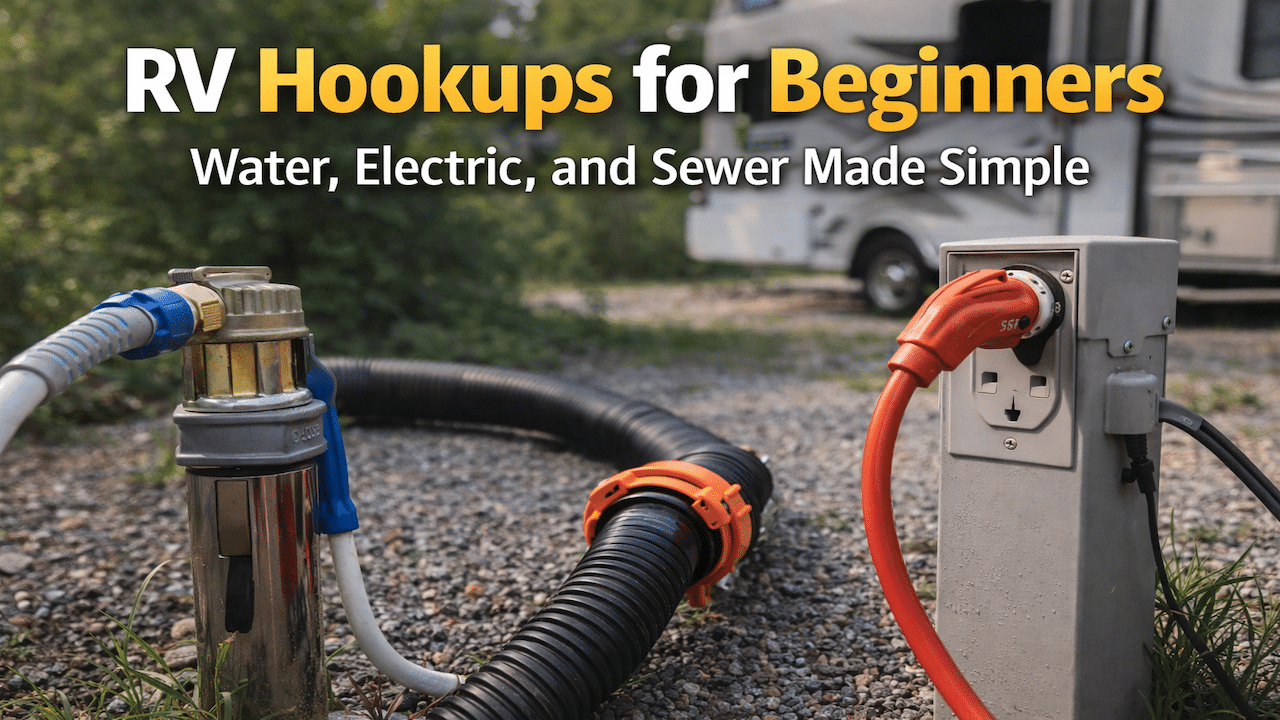
But in reality, RV hookups are just three basic systems:
- water coming in
- electricity coming in
- waste going out
That is it.
Once you simplify it that way, the whole thing starts to feel much more manageable. Your freshwater hose brings clean water into the RV. Your shore power cord connects you to campground electricity. Your sewer hose allows you to empty your holding tanks when the time comes. Each system has its own basic tools and best practices, but they all serve simple purposes.
A lot of beginner stress comes from thinking there must be some hidden complexity. Usually, there is not. What matters most is taking your time, following a routine, and not rushing because someone else seems to be setting up faster than you are.
We have said this many times over the years: slow is smooth, and smooth is fast.
That is especially true at the campsite.
If you are still getting ready for your first trip, you should also read Your First RV Trip: The Step-by-Step Beginner Checklist and How to Plan Your First RV Trip Without Feeling Overwhelmed. Both will help you understand how hookups fit into the bigger flow of arrival day and campground life.
And once you are actually on site, one of the best tools you can have is a step-by-step setup routine you can follow every time. That is exactly why we created our How to Set Up at the Campground Checklist. It gives you a repeatable process so you do not have to trust your memory when you are tired, distracted, or under pressure.
The more routine you make hookups, the less stressful they become. And that begins by realizing this is not magic. It is just three systems, each with a job to do.
2. Fresh Water Hookups, Clean Water In, With a Few Important Safeguards
Fresh water is usually the easiest hookup for beginners to understand, and one of the easiest to do correctly if you use the right equipment.
At most campgrounds, you will see a water spigot near your site. That is your source of pressurized water. To connect safely, you want more than just a hose. You want a drinking-water-safe hose, a water pressure regulator, and in many cases a water filter. Those three items make up the core of a smart freshwater setup.
The pressure regulator is especially important. Campground water pressure can vary a lot, and too much pressure can damage RV plumbing. That little regulator protects your system from getting hammered by unexpectedly high pressure. We consider it essential gear, not optional gear.
The basic connection is simple. Attach the pressure regulator to the campground spigot. If you use a filter, connect that next. Then attach your freshwater hose and connect the other end to the city water inlet on your RV. Turn on the water slowly and check for leaks.
That is really the heart of it.
Some RVers also fill their freshwater tank and run off the onboard pump, especially if they are dry camping or prefer not to stay connected. But for a beginner at a campground with hookups, city water is usually the simplest and easiest method.
One tip we always share with new RVers is to keep your freshwater gear separate from your sewer gear. Different bins, different storage areas, different gloves. You want your clean-water tools to stay clean.
Another useful habit is to never assume a connection is fine just because you tightened it once. After you turn the water on, look. Touch. Check for drips. It takes ten seconds and can prevent a headache later.
If you are still deciding what kind of RV makes sense for you, this is one of those practical things to consider. A smaller, simpler rig often means fewer systems to learn at once. Our article How to Choose Your First RV Without Making an Expensive Mistake can help you think through that bigger decision.
Fresh water hookup is not complicated, but it does reward good habits. Use the right hose. Protect your plumbing with a regulator. Check your connections. Keep your clean-water equipment clean. Do that, and this part of campground life becomes very simple.
3. Electric Hookups, Easier Than They Look if You Respect the Basics
Electric hookups make many beginners nervous because electricity feels invisible and unforgiving.
That is fair. You do want to be careful. But campground electrical hookups are not something to fear if you understand the basics and approach them with respect.
Most RV sites provide either 30-amp service, 50-amp service, or sometimes standard household-style 15/20-amp service. Your RV is designed for one of those main service types, usually 30-amp or 50-amp. The goal is simply to connect your RV to the correct power source safely.
The pedestal at your campsite is where that happens. Before you plug in, make sure the breaker is off. Then connect your RV cord to the correct outlet. If you need an adapter, use the proper one for your setup. Once everything is fully connected, turn the breaker on.
That order matters.
One mistake beginners sometimes make is plugging and unplugging under load or without paying attention to the breaker. A calm, repeatable routine helps protect both you and your RV.
Once connected, your RV can run on campground power instead of battery power. That means you can use outlets, lights, microwave, air conditioner, and other appliances as your rig allows. Exactly what you can run depends on your RV and your service level. A 30-amp rig has different limits than a 50-amp rig, and learning those limits is part of the process.
At first, this can feel confusing. Why can one rig run more than another? Why do breakers trip? Why can you not run every appliance at once?
The answer is simply that electricity has limits, just like your home circuits do. The more familiar you become with your RV's capacity, the more natural it feels.
We have seen many beginners assume power is either on or off, with no nuance involved. Then they discover that running the air conditioner, microwave, and electric water heater all at once may not work on a certain service. That is not failure. That is learning how your RV uses power.
If you are in the early stages of entering this lifestyle and are trying to understand not just the mechanics but the bigger commitment, our Complete Guide to the RV Lifestyle and How Much Does the RV Lifestyle Cost? both help frame the larger picture. Campground hookups are part of the day-to-day reality, and they are much less intimidating once you know what to expect.
4. Sewer Hookups, The Part Everyone Worries About Most
Let us be honest, sewer is the hookup everybody worries about first.
And yes, it is the least glamorous part of RVing. But it is also very manageable once you understand the system and follow a few common-sense rules.
Your RV typically has at least two holding tanks: a black tank for toilet waste and a gray tank for sink and shower water. These tanks do not empty automatically into the campground sewer just because you are connected. You control when they empty by opening and closing the dump valves.
That is an important point for beginners.
To connect, attach your sewer hose securely to the RV outlet and then to the campground sewer inlet. Some campgrounds require a threaded or sealed connection, and in general, a secure fit is always what you want. Again, slow down and check your work.
Now the key habit: keep your black tank valve closed until it is time to dump.
That rule saves beginners from one of the most unpleasant mistakes in RVing. If you leave the black tank open all the time, liquids can drain away while solids stay behind, creating a mess that nobody wants. Let the tank fill enough to dump properly. Then empty it when needed.
A typical sequence is to dump the black tank first, then the gray tank second. The gray water helps rinse the hose a bit on the way out. After dumping, close the valves and disconnect when appropriate.
Use gloves. Keep sewer gear separate from everything else. Rinse equipment if your setup allows. Wash your hands. None of this is difficult, but it is definitely a system where good habits matter.
The fear around sewer is often bigger than the reality. Once you do it a few times, it becomes just another travel-day task. Not your favorite one, perhaps, but no longer a mystery.
This is one reason checklists are so helpful. On departure day, it is easy to forget a valve, a cap, or a sequence step if you are distracted. Our RV Lifestyle Departure Guide Checklist is designed to help with exactly that. It gives you a repeatable routine so you are less likely to miss something important as you get ready to leave.
No one gets into RVing because they love sewer systems. But learning this part well is one of the things that turns a nervous beginner into a confident traveler.
5. The Best Setup Order for Beginners
One of the easiest ways to reduce hookup stress is to have a consistent order every time you arrive at a campsite.
You do not want to reinvent the process on every trip. You want a routine.
Different RVers have slightly different preferences, but a simple beginner-friendly approach looks something like this: park and level the RV, stabilize if needed, connect electric, connect water, then connect sewer if you plan to stay connected during the stay. After that, extend slides if appropriate, set up the inside, and settle in.
Why this order?
Because getting the RV safely positioned and level comes first. Then electricity gives you power for lights, appliances, and comfort. Water comes next, so you can use the sinks, toilet, and shower normally. Sewer connection is usually last because it is the least urgent in the moment and easiest to do once everything else is calm.
This is not about rushing. It is about creating a logical flow that lowers the chance of forgetting something.
We have found that beginners often get flustered, not because hookups are hard, but because arrival feels busy. You are parking, watching for obstacles, checking site position, maybe communicating with your spouse, maybe feeling self-conscious if others are nearby. That is why a checklist matters so much. It removes mental clutter.
The more you can rely on a written process, the less you have to rely on memory under stress.
That is also why we recommend using our How to Set Up at the Campground Checklist every time, especially in the beginning. Print it. Keep it on your phone. Put it where you can see it. There is no prize for doing this from memory.
And before you even get to the campground, it helps to understand the full flow of a first trip from departure through arrival. That is where Your First RV Trip: The Step-by-Step Beginner Checklist and How to Plan Your First RV Trip Without Feeling Overwhelmed come in. They connect the dots around these hookup tasks so the whole experience feels more manageable.
Routine is what turns intimidation into confidence. You do not need to be naturally mechanical. You just need a repeatable process.
6. Common Hookup Mistakes Beginners Make
Most beginner hookup mistakes are not dramatic. They are usually small, preventable, and caused by hurry more than ignorance.
One common mistake is not using a water pressure regulator. That can expose your RV plumbing to more pressure than it should handle. Another is using the wrong hose for freshwater. Your drinking-water hose should not be the same hose you use for rinsing dirty equipment or handling sewer tasks.
With electricity, a frequent beginner mistake is plugging in carelessly or not paying attention to service type. Another is trying to run too many power-hungry appliances at once without understanding the limits of the rig's electrical system.
And then there is sewer, where the classic mistake is leaving the black tank valve open all the time. That one mistake creates more misery than almost any other beginner error. Another sewer mistake is poor hose connection, often because someone rushed or assumed it was secure without checking.
A broader mistake, and maybe the biggest one of all, is feeling pressured to go fast. Campgrounds can make beginners self-conscious. Maybe a neighbor is already in their chair with a drink while you are still figuring out where to connect your water hose. That is fine. Let them relax. You take your time.
We have learned that most campsite problems happen when people rush, skip steps, or stop checking the obvious things. A loose fitting. A breaker left on. A valve in the wrong position. A missed item on departure. These are not signs that you are bad at RVing. They are signs that routine matters.
That is also why beginner-friendly education matters. The more you understand the systems, the less likely you are to panic when something small goes wrong. And that bigger educational base is exactly why we build these posts as a connected cluster. If you are new, read through the sequence:
- Complete Guide to the RV Lifestyle
- How Much Does the RV Lifestyle Cost?
- How to Choose Your First RV Without Making an Expensive Mistake
- How to Plan Your First RV Trip Without Feeling Overwhelmed
- Your First RV Trip: The Step-by-Step Beginner Checklist
Each article supports a different part of the learning curve.
7. Confidence Comes From Repetition, Not Perfection
There is a reason hookups feel easier for experienced RVers. It is not because they were born knowing what to do. It is because they have repeated the process enough times that it no longer feels foreign.
That is good news, because it means confidence is not something you either have or do not have. It is something you build.
The first time you connect water, you may double-check every fitting three times. The first time you plug into shore power, you may pause and wonder if you forgot a step. The first time you dump tanks, you may move slowly and feel nervous. That is normal.
After a few trips, these tasks start to settle into muscle memory.
You begin to know where your gear is stored. You stop fumbling for the right hose. You recognize your routine. You see the campsite utilities and feel less like they are a puzzle and more like they are simply the next step in setting up home.
That is one reason we so strongly encourage beginners to start small and keep the first few trips simple. Nearby campgrounds, manageable stays, good checklists, and realistic expectations all help you get the repetitions you need without piling on unnecessary pressure.
The goal is not to perform every hookup perfectly on trip one. The goal is to learn enough each time that the next trip feels easier.
And honestly, that is true of the whole RV lifestyle.
If you want a place to ask beginner questions, compare notes with other RVers, and learn from people who have already walked through this stage, our private, ad-free RV Lifestyle Community can be a real help. A lot of new RVers gain confidence simply by realizing their questions are normal and their learning curve is shared by almost everyone.
Hookups are not a test of whether you belong in the RV lifestyle. They are just part of the routine. And like every routine, they get easier the more you do them.
FAQ: RV Hookups for Beginners
What hookups do you need at an RV campsite?
Most RV campsites offer some combination of water, electric, and sewer hookups. Full hookup sites include all three, while other sites may offer only electric and water, or just electric.
Do beginners need full hookups?
Full hookups are usually the easiest choice for beginners because they simplify the experience. Having water, power, and sewer at the site makes it easier to learn campground routines without adding extra complexity.
What order should you connect RV hookups?
A simple beginner routine is to park and level first, then connect electric, connect water, and connect sewer last if needed. The most important thing is to follow the same routine every time.
Should you leave your black tank open when connected to sewer?
No. In most cases, you should keep the black tank valve closed until it is time to dump. Leaving it open can allow liquids to drain away while solids remain behind, creating unpleasant buildup.
What do you need for RV water hookups?
At a minimum, you should have a drinking-water-safe hose and a water pressure regulator. Many RVers also use a water filter for added protection and better water quality.
About the Authors
Mike Wendland is an award-winning journalist and longtime broadcaster who, along with his wife Jennifer, has spent more than 15 years traveling North America by RV. Together, they are the founders of RVLifestyle.com, the RV Podcast, and the RV Lifestyle Community, where they share trusted advice on RV travel, trip planning, gear, campgrounds, and the realities of life on the road. Their mission is to help RVers, especially beginners, travel with more confidence, clarity, and joy.
More RV Lifestyle Resources to Help You Succeed on the Road
If this guide has sparked your interest in the RV lifestyle, we have created a full ecosystem of resources to help you learn faster, travel smarter, and connect with other RVers who share your passion for the open road.
RV Lifestyle Travel Guides: Expert Pre-Planned RV Trips
Our detailed RV travel guides take the guesswork out of trip planning. Each guide includes scenic routes, must-see attractions, handpicked campgrounds, and daily driving plans designed specifically for RV travelers.
Explore them here:
https://shop.rvlifestyle.com
RV Lifestyle Community: A Friendly Private Community for RVers
Join thousands of RVers in our private online community where you can ask questions, share experiences, get fast answers from experienced travelers, and participate in member-only events, livestreams, and rallies.
Learn more here:
https://rvcommunity.com
The RV Podcast: Weekly RV News, Tips, and Travel Stories
Our weekly RV Podcast features practical advice, industry news, campground discoveries, and inspiring stories from fellow RV travelers.
Listen here:
https://rvpodcast.com
RV Lifestyle YouTube Channel: RV Tours, Travel Tips, and Adventures
Watch RV tours, campground reviews, travel adventures, and practical how-to videos from Mike and Jen as they explore North America by RV.
Watch here:
https://youtube.com/@RVLifestyle
RV Lifestyle Masterclass: Learn Everything About RV Living
Our step-by-step RV Lifestyle Masterclass teaches everything you need to know about choosing an RV, traveling confidently, maintaining your rig, saving money on the road, and building the RV lifestyle you dream about.
Learn more here:
https://shop.rvlifestyle.com
RV hookups may seem intimidating at first, but they are one of those parts of RV life that become much easier once you understand the basics and build a simple routine. Take your time, use the right gear, follow your checklists, and let experience do what experience always does, make the unfamiliar feel normal.
Be sure to explore these resources and continue learning, traveling, connecting, and growing with us.
Happy Trails!
Life’s Best Chapter Starts Here
in the RV Community

You’ve raised the kids. Done the 9-to-5. Now it’s your time.
Join a private, ad-free community built just for RVers who crave connection, adventure, and meaningful conversation.
- In-person meetups & rallies
- Twice a week member only livestreams and Virtual Campfires that are pure fun
- Exclusive courses on mastering the RV lifestyle
- Real people. No drama. No ads.
- Special interest spaces for more than two dozen RV subjects
Because the open road is better with friends. Check it out here https://RVCommunity.com

