
How to Plan Your First RV Trip Without Feeling Overwhelmed
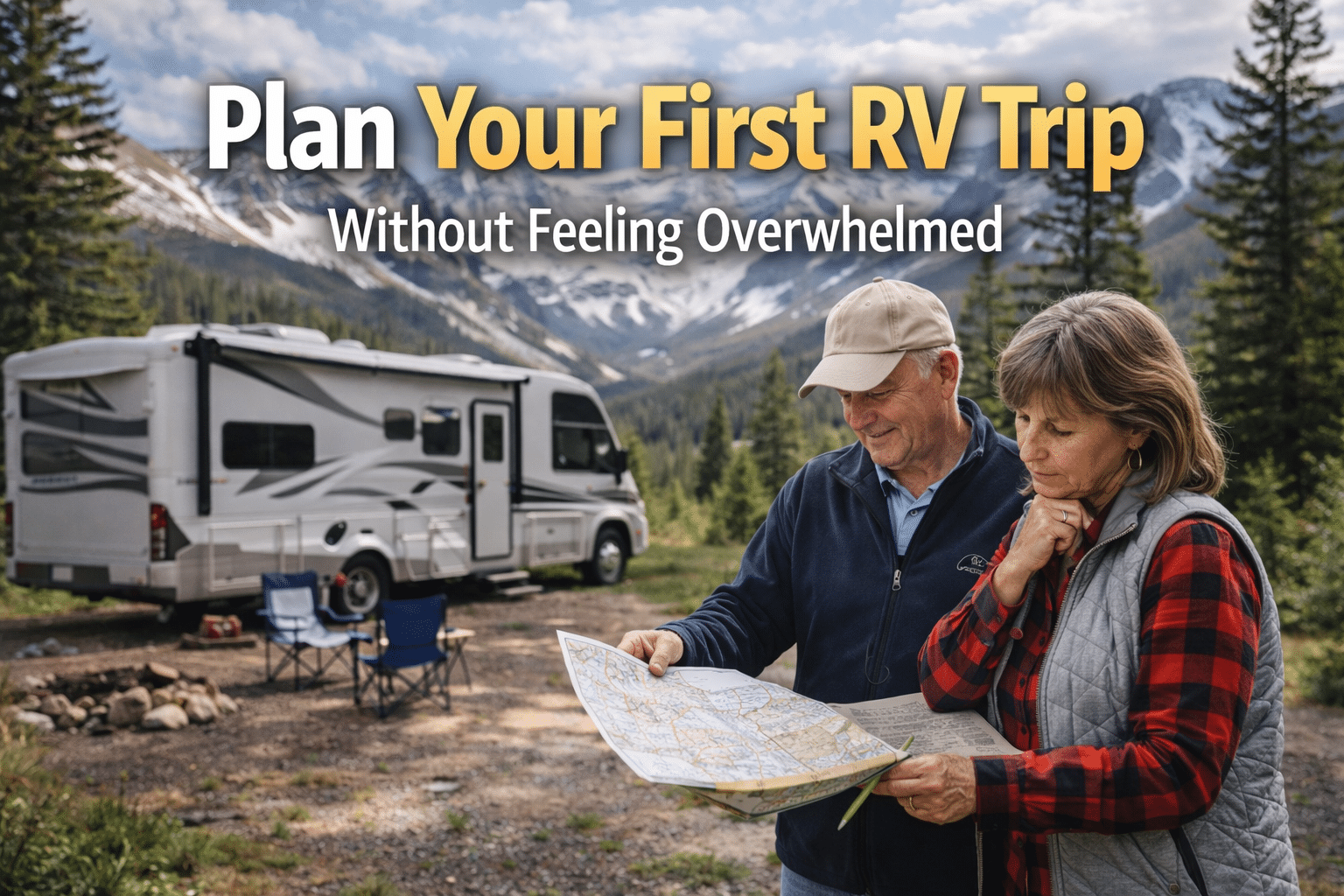
Introduction
Planning your first RV trip can feel like one of those moments where excitement and uncertainty show up at exactly the same time.
You are dreaming about the open road, scenic campgrounds, morning coffee outside, and the freedom to go where you want, when you want. But then the questions start coming. Where should we go? How far should we drive? What kind of campground should we book? What do we need to pack? How do we make sure we do not forget something important?
If that sounds familiar, you are not alone.
Over the years, we have heard from countless new RVers who were eager to get started but felt stuck in the planning stage. They were not afraid of adventure. They were afraid of making mistakes, spending too much money, booking the wrong campground, driving too far, or turning what should be a fun first trip into a stressful experience.
The good news is this: your first RV trip does not need to be complicated to be memorable.
In fact, the best first RV trips are usually the simplest ones. A short route. A realistic driving day. A beginner-friendly campground. A few easy meals. A little room for trial and error. That is how confidence is built.
This article is designed to help you plan that first trip in a way that feels manageable, practical, and enjoyable. Think of it as the next step after dreaming, researching, and choosing your RV. If you want the bigger picture of what this lifestyle is all about, start with our Complete Guide to the RV Lifestyle. But if you are ready to actually put a first trip on the calendar, this guide will help you do it without feeling overwhelmed.
1. Start With a Short, Simple Destination
One of the biggest planning mistakes first-time RVers make is trying to turn the first trip into the trip of a lifetime.
We understand the temptation. Once you have the RV, or are preparing to rent one, it is easy to imagine heading straight to Yellowstone, the Blue Ridge Parkway, or a month-long cross-country loop. But your first trip is not the time to test your endurance, driving stamina, and problem-solving skills all at once.
It is the time to build confidence.
That is why we always recommend choosing a destination close to home for your first outing, ideally one to three hours away. A short drive gives you a chance to focus on the real purpose of the trip: learning how your RV works, getting used to campground life, and discovering what you enjoy most about traveling this way.
A nearby state park, county park, or private campground can be perfect. You do not need a bucket-list destination to have a meaningful first experience. In fact, simple is often better. A manageable drive means less pressure. If you forget something, home is not far away. If you run into a setup challenge, you are not doing it after an exhausting all-day drive.
We have known many new RVers who overloaded that first trip with too much distance and too many expectations. By the time they arrived, they were tired, tense, and too busy managing logistics to enjoy the moment. On the other hand, those who started close to home often came back saying the same thing: “That was easier than we expected. We are ready to go again.”
That is exactly what you want.
If you are still deciding what kind of rig makes the most sense for how you want to travel, our article How to Choose Your First RV Without Making an Expensive Mistake can help you think through the kind of setup that best fits your plans. The more realistic you are about how you will travel, the easier trip planning becomes.
For your first destination, aim for easy access, simple roads, and a campground with good reviews from other RVers. You are not trying to impress anyone. You are trying to create a smooth, encouraging beginning.
2. Decide How Many Nights to Stay
When it comes to a first RV trip, longer is not always better.
In fact, one of the smartest planning choices you can make is keeping your first trip short enough to feel comfortable, but long enough to give you a real experience. For most beginners, that means two or three nights.
A one-night trip can feel rushed. By the time you drive there, check in, get set up, settle down, and then start packing up again the next morning, it may feel like more work than fun. A week-long trip, on the other hand, can be too much for a first outing, especially if you are still learning your systems, routines, and preferences.
Two or three nights usually hits the sweet spot.
That gives you time to arrive without panic, enjoy a full day or two at the campground, and then head home with enough experience to understand what worked and what needs adjustment. It is long enough to practice using the kitchen, bathroom, hookups, storage, and sleeping arrangements. It is short enough that if things feel clunky or imperfect, you know you are not locked into a long, stressful journey.
We often tell new RVers to think of the first trip as a learning trip, not a performance. You are not trying to prove you can live on the road for weeks. You are simply taking the first real step.
This is also important from a budgeting standpoint. A shorter first trip keeps campground fees, fuel costs, and food expenses more predictable while you get a feel for how much RV travel actually costs for you. If that part of the equation is still fuzzy, read How Much Does the RV Lifestyle Cost?. It will help you set realistic expectations before you start stacking reservations and travel days onto the calendar.
Another advantage of a short trip is that it usually leaves you wanting more. That is a good thing. A successful first trip should not leave you feeling drained. It should leave you feeling encouraged.
If everything goes smoothly, wonderful. If you hit a few bumps, no problem. You are home soon, with a much clearer sense of what your second trip should look like. That is how confidence grows, one manageable experience at a time.
3. Choose a Beginner-Friendly Campground
Not all campgrounds are equally well-suited for first-time RVers.
Some are perfect for easing into the lifestyle. Others can make a beginner feel stressed before the fun even begins. That is why your campground choice matters so much.
For your first trip, we recommend keeping it simple. Look for a campground with easy access roads, spacious sites, good reviews, and, if possible, full hookups. Full hookups mean you will have electric, water, and sewer right at your site, which takes a lot of uncertainty out of the experience. You can focus on learning the basics without also trying to conserve water, manage tanks more aggressively, or troubleshoot limited services.
A private campground can be a very good first choice because sites are often easier to access and utility connections are usually straightforward. Many state parks are wonderful too, but some have tighter sites, less room to maneuver, or fewer hookups. They can be great once you have a little experience, but for a first trip, convenience is not a bad thing.
Read reviews carefully. Look for comments about road width, site spacing, tree clearance, ease of parking, cleanliness, and quiet. If backing into a site makes you nervous, look for a pull-through. There is no shame in making this easier on yourself.
We have talked to many beginners who assumed any campground would do, only to discover after arrival that the roads were tight, the site was unlevel, or the hookups were awkwardly placed. That does not mean the campground was bad. It simply was not ideal for someone still learning.
When you are planning, try to think ahead about what will lower stress. Wide turns, clear signage, manageable site layouts, and accessible amenities can make a huge difference. You want your first campground to feel welcoming, not intimidating.
This is also where your first-trip mindset matters. You are not choosing the most remote or exotic place. You are choosing a place where you can arrive calmly, get set up, enjoy the experience, and come home more confident than when you left.
And after you book it, keep going with the preparation by reviewing our Your First RV Trip: The Step-by-Step Beginner Checklist. That article will help you think through what happens after the reservation is made, from departure to arrival and everything in between.
4. Plan a Relaxed Driving Day
If there is one thing that can make a first RV trip feel overwhelming fast, it is trying to drive too far in one day.
RV travel is different from car travel. You go slower. You stop differently. Fueling takes more thought. Rest breaks take more planning. And if you are towing or driving a larger rig, every mile requires a little more attention. That is not a bad thing, but it does mean your driving day should be planned with more margin than you might expect.
For your first trip, keep it short. A drive of two to three hours is usually plenty. Even if that sounds modest, remember that by the time you finish loading, checking systems, getting on the road, possibly stopping for fuel, and arriving at the campground, you will have had a full day.
One of the smartest habits you can develop early is planning to arrive well before dark. Daylight makes everything easier. You can see your site clearly. You can identify utility hookups. You can check tree branches and obstacles. And you can settle in without that creeping feeling of being rushed.
We have arrived late before, and even after years on the road, it is never our favorite way to start a stay. For beginners, late arrivals can magnify every little challenge.
Another helpful tip is to choose the easiest route, not necessarily the shortest one. Wider roads, fewer turns, and less traffic are almost always worth a few extra miles. Avoid complex urban driving if you can. Avoid tight shortcuts. Avoid steep or unfamiliar routes on the first trip unless there is no practical alternative.
And talk through your driving roles ahead of time. If one of you is driving and the other is navigating, decide how you will communicate. Clear, calm directions are much more helpful than last-second instructions or criticism. That one small decision can save a lot of frustration.
A relaxed driving day sets the tone for the whole trip. You want to arrive feeling alert and encouraged, not wrung out. The goal is not to cover distance. The goal is to reach the campground ready to enjoy yourself.
5. Reserve What Matters, but Do Not Overplan Every Minute
One of the easiest ways to overwhelm yourself before a first RV trip is to confuse planning with overplanning.
Yes, you need to make a few key decisions in advance. You need a campground reservation. You need a route. You need a rough sense of meals, supplies, and departure timing. But you do not need to schedule every meal, every stop, every scenic detour, and every hour of every day.
In our experience, that kind of overplanning creates stress, not freedom.
The beauty of RV travel is that it gives you room to breathe. Even a short trip should still feel flexible enough that you can linger over coffee, take an extra walk, or change your plans if the weather shifts. Beginners often think the answer to uncertainty is more control. Usually, the better answer is a simple framework with plenty of room inside it.
Reserve the campground, especially if you are traveling during a busy season or going to a popular area. Make sure you know check-in times and any arrival instructions. If you have a larger rig, double-check site length and access notes. Plan your route. Have your supplies ready. That is the important stuff.
Beyond that, keep things light.
Maybe you know one nearby attraction you would like to visit. Great. Maybe you plan one simple dinner at the campsite and one meal out. Fine. But leave some open space in the trip. Some of the best RV memories come from the moments you did not script, an evening under the awning after the rain, a chat with the neighbors, a quiet walk around the campground at sunset.
We have learned over time that too much structure can make the road feel strangely rigid. RVing is supposed to feel a little more spacious than everyday life, not more tightly choreographed.
If you are still in the early stages of imagining how all of this fits together, our Complete Guide to the RV Lifestyle can help you see the broader picture. But when it comes to the first trip itself, simpler is almost always better.
Reserve the essentials. Let the rest unfold a little.
6. Make a Practical Packing and Prep List
Packing for your first RV trip does not need to feel like preparing for an expedition to the Arctic.
In fact, one of the most common beginner problems is overpacking, not underpacking. New RVers often bring far more than they need because they are afraid of being caught without something important. The result is clutter, confusion, and a cramped living space before the trip even starts.
A better approach is to pack for a comfortable few days and trust that you can adjust later.
Start with the essentials: bedding, towels, toiletries, clothing appropriate for the weather, medications, simple groceries, coffee supplies, chargers, camp chairs, and basic kitchen items. Add the RV-specific setup gear you need, things like your freshwater hose, sewer hose, electrical cords or adapters, water pressure regulator, gloves, and leveling blocks if required.
Then stop and ask yourself: do we really need this for a two- or three-night trip?
That question can save you from hauling along half the garage.
We always recommend that new RVers create two separate lists, one for household and personal items, and one for RV setup and travel-day tasks. The second list is often the more important one. It should include items like checking tire pressure, securing loose items inside, latching storage compartments, stowing steps, retracting slides, and making sure nothing is left connected when it is time to leave.
This is where checklists become your best friend. Even experienced RVers use them because there are simply too many little things to rely on memory alone.
Meal planning also helps. Keep it simple for the first trip. Sandwiches, easy breakfasts, grilled burgers, soup, or a basic crockpot dinner can make life much easier than trying to cook elaborate meals in a space you are still getting used to.
And remember, your first trip is also a data-gathering trip. You will learn what you actually use, what you forgot, and what you never needed at all. That is part of the process. Do not aim for perfect packing. Aim for functional, comfortable, and manageable.
7. Build in Flexibility, and Expect a Few Imperfect Moments
If you want your first RV trip to feel less overwhelming, give yourself permission not to do everything perfectly.
That may sound simple, but it is one of the most important planning principles we know.
Something will probably go a little sideways. You may forget an adapter. You may take longer than expected to back into the site. You may need to look up how something works, or run to a store for a basic item you thought you packed. None of that means the trip is failing. It means you are learning.
The first RV trip is not about performance. It is about experience.
The people who enjoy their first trips the most are usually not the ones who avoided every little problem. They are the ones who left enough margin in the day, and enough grace in their expectations, that small problems stayed small.
That is why flexibility matters so much. If you are too tightly scheduled, every delay feels like a crisis. If you leave room in your plans, most hiccups become stories you laugh about later.
We have had plenty of travel days over the years where something took longer than expected, weather changed the plan, or a campground arrival was not as smooth as we hoped. That is not unusual. It is just part of life on the road. The key is learning how to respond without letting the moment define the whole trip.
This is also why community helps. If you are the kind of person who feels more confident when you can ask questions and hear from others who have already done it, our private, ad-free RV Lifestyle Community can be a wonderful support system. New RVers often tell us how reassuring it is to have a place where they can ask beginner questions, compare notes, and get fast answers without the noise and snark that often show up on social media.
The road gets easier with experience. But it also gets easier when you stop expecting it to go flawlessly.
8. Common First-Trip Planning Mistakes to Avoid
By the time people reach the planning stage, they often think the hard part should be over. But in many ways, this is where first-time stress can sneak in.
One common mistake is choosing a destination that is too far away. Long drives add fatigue, reduce flexibility, and make every other part of the day feel harder. Another is booking a campground that may be beautiful, but is not beginner-friendly in terms of access, hookups, or site layout.
Overpacking is another classic problem. So is overplanning. When every hour is booked, there is no margin for rest, weather, setup delays, or just enjoying the experience. Then there is the mistake of arriving too late, which can turn a simple setup into a stressful scramble.
Some people also underestimate how much emotional energy the first trip can take. Even exciting things can feel tiring when they are new. That is why shorter stays, easier routes, and more breathing room usually work better than ambitious itineraries.
Another mistake is treating the trip like a final exam instead of a first step. Your first trip does not need to prove that you are ready for full-time travel, mountain roads, or a six-state itinerary. It just needs to get you out there.
And finally, many beginners forget to use the internal resources already available to them. This is exactly why we build pillar and support content around the real questions new RVers ask. If you are working your way into this lifestyle, use the whole cluster:
- Complete Guide to the RV Lifestyle
- How Much Does the RV Lifestyle Cost?
- How to Choose Your First RV Without Making an Expensive Mistake
- Your First RV Trip: The Step-by-Step Beginner Checklist
Each one helps answer a different part of the beginner journey.
FAQ: How to Plan Your First RV Trip
How far should your first RV trip be?
For most beginners, your first RV trip should be close to home, ideally one to three hours away. A shorter drive lowers stress and gives you more time and energy to focus on learning the RV and enjoying the campground.
How many nights should a first RV trip last?
Two or three nights is usually ideal. It gives you enough time to settle in, practice your routines, and enjoy the experience without making the trip feel too long or too complicated.
What kind of campground is best for a first RV trip?
A beginner-friendly campground with easy access, good reviews, roomy sites, and preferably full hookups is usually the best choice for a first trip. Convenience helps build confidence.
Should you plan every detail of your first RV trip?
No. You should reserve the key things, like the campground and route, but avoid overplanning every hour. Leaving room for flexibility makes the trip less stressful and more enjoyable.
What is the biggest first-trip planning mistake?
One of the biggest mistakes is trying to do too much, too far from home, with too many moving parts. Simplicity is what makes a first RV trip successful.
About the Authors
Mike Wendland is an award-winning journalist and longtime broadcaster who, along with his wife Jennifer, has spent more than 15 years traveling North America by RV. Together, they are the founders of RVLifestyle.com, the RV Podcast, and the RV Lifestyle Community, where they share trusted advice on RV travel, trip planning, gear, campgrounds, and the realities of life on the road. Their mission is to help RVers, especially beginners, travel with more confidence, clarity, and joy.
More RV Lifestyle Resources to Help You Succeed on the Road
If this guide has sparked your interest in the RV lifestyle, we have created a full ecosystem of resources to help you learn faster, travel smarter, and connect with other RVers who share your passion for the open road.
RV Lifestyle Travel Guides: Expert Pre-Planned RV Trips
Our detailed RV travel guides take the guesswork out of trip planning. Each guide includes scenic routes, must-see attractions, handpicked campgrounds, and daily driving plans designed specifically for RV travelers.
Explore them here:
https://shop.rvlifestyle.com
RV Lifestyle Community: A Friendly Private Community for RVers
Join thousands of RVers in our private online community where you can ask questions, share experiences, get fast answers from experienced travelers, and participate in member-only events, livestreams, and rallies.
Learn more here:
https://rvcommunity.com
The RV Podcast: Weekly RV News, Tips, and Travel Stories
Our weekly RV Podcast features practical advice, industry news, campground discoveries, and inspiring stories from fellow RV travelers.
Listen here:
https://rvpodcast.com
RV Lifestyle YouTube Channel: RV Tours, Travel Tips, and Adventures
Watch RV tours, campground reviews, travel adventures, and practical how-to videos from Mike and Jen as they explore North America by RV.
Watch here:
https://youtube.com/@RVLifestyle
RV Lifestyle Masterclass: Learn Everything About RV Living
Our step-by-step RV Lifestyle Masterclass teaches everything you need to know about choosing an RV, traveling confidently, maintaining your rig, saving money on the road, and building the RV lifestyle you dream about.
Learn more here:
https://shop.rvlifestyle.com
Planning your first RV trip does not have to feel intimidating. Keep it simple, keep it realistic, and remember that confidence is built one small success at a time. The road has a way of teaching you what you need to know, especially when you give yourself the freedom to learn as you go.
Be sure to explore these resources and continue learning, traveling, connecting, and growing with us.
Happy Trails!

