10 Beginner RV Mistakes That Can Ruin Your First Year on the Road
Introduction
The first year of RVing is exciting, eye-opening, and sometimes humbling.
It is the year when the dream finally becomes real. You start imagining weekend escapes, longer adventures, beautiful campgrounds, scenic backroads, and the freedom to take your home with you. It is also the year when a lot of new RVers discover that the lifestyle has a learning curve.
That is not a bad thing. In fact, it is part of what makes RV travel so rewarding. You learn by doing. You figure out what kind of travel you enjoy, what kind of setup works best for you, and how to make life on the road smoother, simpler, and more fun.
But here is the truth: some beginner mistakes are minor and funny, while others can cost you time, money, confidence, and enjoyment. We have met plenty of first-time RVers who got discouraged not because they were not cut out for the lifestyle, but because they made a few preventable mistakes early on and started to think they were failing.
They were not failing. They were learning.
Still, if you can avoid some of the more common early mistakes, your first year on the road will be a whole lot better.
This guide is designed to help you do exactly that. These are the mistakes we see new RVers make again and again, and a few we have lived through ourselves over the years. If you are just starting out, or even still dreaming and planning, begin with our Start Here page and our Complete Guide to the RV Lifestyle. Those pages lay the foundation. This article is here to help you avoid the pitfalls that can make that first year harder than it needs to be.
1. Buying the Wrong RV for the Way You Actually Travel
This may be the most expensive beginner mistake of all.
A lot of people buy their first RV based on appearance, emotion, or fantasy rather than how they will really use it. They fall in love with the giant kitchen, the big TV, the fancy seating, or the idea of all that space, but they do not think enough about where they will camp, how far they want to drive, how comfortable they are towing, or what kind of trips they will actually take.
That disconnect causes problems fast.
A rig that feels luxurious on a dealer lot can feel stressful on a mountain road, frustrating in a tight campground, or far more expensive to fuel, store, and maintain than expected. On the other hand, some beginners go too small because they are nervous, then realize they do not have enough living space for the trips they want to take.
The happiest first-year RVers are usually the ones who choose a rig that matches their real travel style, not an imagined version of themselves.
That is why one of the most important pieces of beginner reading is How to Choose Your First RV Without Making an Expensive Mistake. It walks through the bigger questions that should guide your decision, including size, towability, budget, and lifestyle fit.
If you are brand new to all of this, the smartest thing you can do is slow down. Ask how you want to travel. How long will you stay out? Will you move often or stay parked for days at a time? Do you prefer state parks, private campgrounds, or long regional road trips? Your answers matter more than whatever is getting the most attention at the RV show.
The goal is not to buy the biggest or flashiest RV. It is to buy the right RV for your life.
2. Underestimating What the RV Lifestyle Really Costs
The purchase price is only the beginning.
That is one of the biggest surprises for new RVers. They plan for the rig itself, maybe for insurance and registration too, but they often underestimate all the other expenses that come with actually traveling. Fuel, campground fees, maintenance, repairs, accessories, hoses, surge protectors, leveling gear, storage, propane, and all the little things that add up, they can make the first year feel more expensive than expected.
That does not mean RVing is not worth it. It does mean you need realistic expectations.
One of the quickest ways to sour the first year is to go into it with a fuzzy sense of the numbers. Budget stress takes the joy out of travel fast. We have talked to many first-year RVers who loved the lifestyle itself but got frustrated because they had not built a real travel budget.
That is exactly why we created How Much Does the RV Lifestyle Cost?. It helps you think beyond the sticker price and understand the bigger financial picture.
And this is also where planning tools can make a huge difference. If you want one place to organize routes, stops, costs, reservations, and trip details, take a look at the RV Lifestyle Travel Planning Center. That is where you can find our apps and tools, including the Trip Planning Dashboard, which is designed to help RVers keep all the moving pieces of a trip in one place.
The more clearly you see the costs, the less likely you are to feel blindsided by them.
3. Trying to Take a Huge First Trip
One of the fastest ways to ruin early confidence is to make the first trip too big.
We see this all the time. A new RVer buys the rig, loads it up, and immediately plans a six-state journey, a week-long mountain loop, or a marathon drive that would be tiring even in a car. It feels exciting when you are planning it. It often feels very different once you are actually on the road.
Long driving days, unfamiliar systems, setup stress, fuel stops, traffic, weather, and simple fatigue all hit harder when everything is new.
The better approach is almost always to start small.
A short trip close to home gives you the chance to practice the real rhythm of RV travel without overwhelming yourself. You learn what works, what you forgot, how setup feels, how driving feels, and what you would change next time. That is how confidence grows, not from one heroic trip, but from a series of successful, manageable ones.
Our article Your First RV Trip: The Step-by-Step Beginner Checklist was written for exactly this reason. It helps you think through the first outing in a way that lowers stress and builds confidence.
And if you are still in the planning stage, read How to Plan Your First RV Trip Without Feeling Overwhelmed. It can help you avoid turning what should be a fun introduction into an exhausting trial by fire.
The first trip should leave you saying, “We can do this.” Not, “What have we gotten ourselves into?”
4. Skipping Practice Before Driving for Real
This mistake is more common than you might think.
A surprising number of new RVers take delivery of a motorhome or towable and then basically learn on the fly. The first real highway run becomes the first real lesson. The first back-in campsite becomes the first time they have tried backing into anything. The first stressful fuel stop becomes the moment they start realizing how differently an RV moves compared to a car.
That is too much pressure.
Driving confidence comes from familiarity, and familiarity comes from practice. Empty parking lots, quiet roads, gentle turns, backing practice, braking practice, these are all part of learning the rig before real-world stress gets layered on top.
This is why How to Drive an RV for the First Time With Confidence is such an important beginner article. It walks through the mindset and skills that help new RVers feel more prepared behind the wheel.
You do not have to become an expert before your first trip. You do need to know how the RV feels, how it turns, how much room it needs, how the mirrors work, and how to stay calm when something unexpected happens.
That little bit of early practice can save you from a lot of first-year stress. It also helps couples communicate better, because both people begin to understand what the driver is dealing with.
Practice may not feel glamorous. But it is one of the smartest things you can do in the first year.
5. Not Learning Hookups and Setup Routines Early
Water, electric, sewer, leveling, slides, and setup order can feel intimidating at first, but the real mistake is not that they are unfamiliar. The real mistake is avoiding learning them until you are under pressure.
A lot of new RVers wait until they arrive at the campground to figure everything out in real time. That is when stress takes over. People are tired from driving. The site may be tight. Other campers may be nearby. One person is trying to direct while the other is fumbling with hoses and power cords.
That is when simple tasks start to feel much harder than they really are.
The better approach is to build a routine early.
Our article RV Hookups for Beginners: Water, Electric, and Sewer Made Simple breaks down the systems in plain English so they stop feeling mysterious. And we strongly recommend using our two checklists to make setup and departure feel repeatable instead of chaotic:
These are the kinds of tools that save you from forgetting a step, leaving something connected, or getting out of sequence when you are tired.
The first year goes much better when you stop reinventing the process every time. Routine is what turns intimidation into confidence.
6. Overpacking and Overcomplicating Everything
New RVers often pack like they are leaving for six months in the wilderness.
The result is too much stuff, not enough space, clutter everywhere, overloaded compartments, and a lot of frustration trying to find things. We have seen beginners fill their rigs with gear they never use because they are afraid of forgetting something important.
That is understandable, but it creates its own problems.
The same thing happens with trip planning. Some first-year RVers overcomplicate every route, overbook every day, overresearch every stop, and create so much structure that the trip feels like a military operation instead of an adventure.
RV life gets much easier when you simplify.
Pack for a few comfortable days, not every possible emergency. Plan the important parts of the trip, but leave some room to breathe. Keep meals simple. Keep driving days reasonable. Keep campground choices beginner-friendly. Use tools to help you organize, not to make the process more complicated.
If you want one place to keep your route, reservations, notes, budget, and trip details organized, the RV Lifestyle Travel Planning Center is worth exploring. That is where the Trip Planning Dashboard and other RV Lifestyle planning tools can help. The goal is not to add more moving parts. It is to replace the chaos of ten different notes, apps, printouts, and scattered reminders with one organized system.
Your first year should get simpler as you go, not more tangled.
7. Choosing Campgrounds That Add Stress Instead of Reducing It
Where you stay matters more than many beginners realize.
A beautiful campground is not automatically the right campground for your first year. Tight turns, small sites, limited hookups, steep grades, low branches, and difficult backing situations can all make a site much more stressful for someone who is still learning.
That does not mean those campgrounds are bad. It just means they may not be beginner-friendly.
One of the best things you can do in your first year is choose campgrounds that help you succeed. Wider roads. Clear access. Full hookups when possible. Pull-through sites if backing still feels intimidating. Good reviews from other RVers. A little extra convenience early on is not “cheating.” It is smart.
A lot of first-year confidence is built or damaged by the kinds of campgrounds you choose.
If you are still shaping your early travel strategy, your Start Here page is a good beginning, because it points new RVers toward the resources that make those early decisions easier.
The simpler your early campground choices, the more mental energy you have left to actually enjoy the lifestyle.
8. Treating Every Problem Like a Sign You Are Failing
This may be the biggest emotional mistake beginners make.
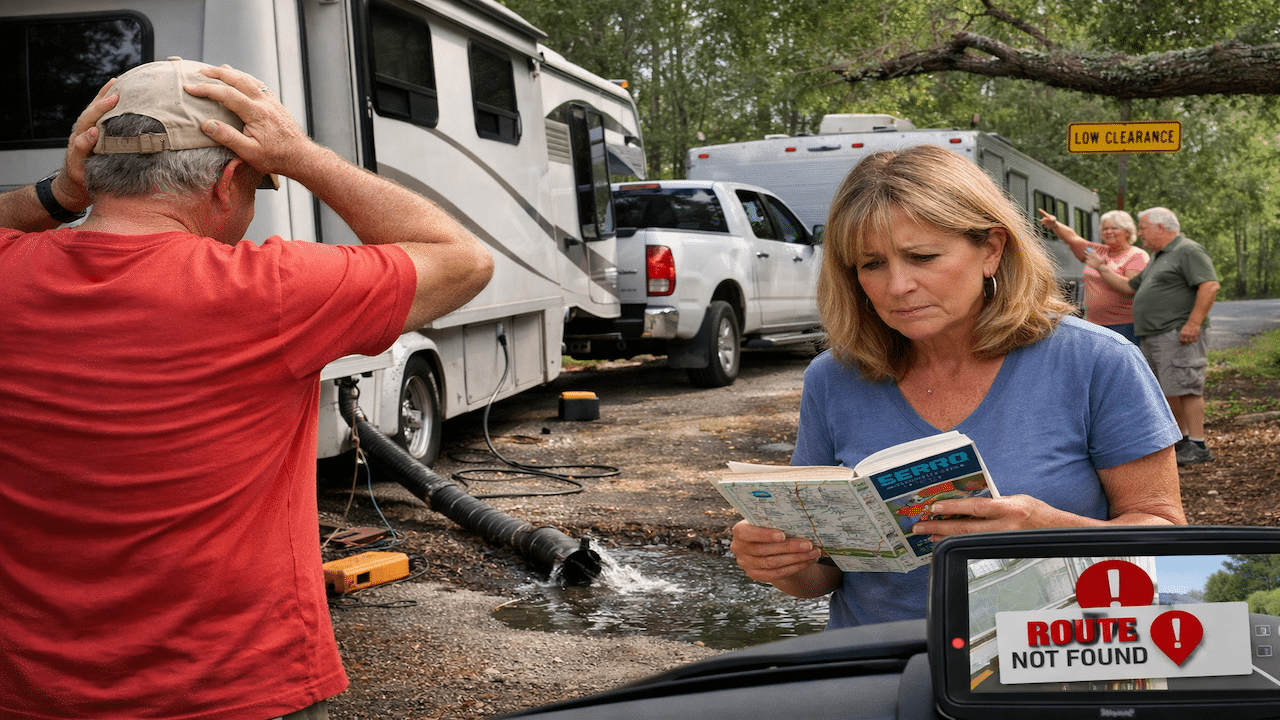
Something goes wrong, a missed turn, a forgotten adapter, a stressful setup, a tank issue, a tight fuel stop, and suddenly they start telling themselves they are bad at RVing. They think everyone else has it figured out and they do not.
That is simply not true.
Every experienced RVer has stories. Wrong turns. Awkward arrivals. Dump station mishaps. Forgotten gear. Stressful weather. Tight campgrounds. The difference is not that seasoned RVers never make mistakes. It is that they no longer interpret every mistake as evidence they should quit.
The first year on the road is full of learning moments. Some are smooth. Some are humbling. All of them are part of the process.
That is why it helps to stay connected to real people who understand the journey. It also helps to keep good resources close at hand, so when you hit a rough patch, you can find answers instead of spiraling into self-doubt.
The RV lifestyle is not for perfect people. It is for people willing to learn.
9. Ignoring Helpful Systems and Tools
A lot of beginners try to manage RV life with random scraps of paper, memory, text messages, screenshots, and whatever happens to be open on their phone at the moment.
That may work for a weekend or two. It becomes a problem fast.
When travel details are scattered, mistakes multiply. Reservation confusion. Forgotten campground info. Missed checklist steps. No clear budget tracking. Uncertainty about routes, stops, and timing. Chaos loves disorganization.
This is exactly why having a planning system matters.
The RV Lifestyle Travel Planning Center was built to give RVers a better way to organize travel. If you are trying to simplify your first year, the Trip Planning Dashboard is one of the most practical tools you can use. It helps put your route, stops, reservations, notes, and trip details in one place instead of all over the map.
And if you are still figuring out where to begin with all the RV Lifestyle resources, go to Start Here. It is designed to point new RVers toward the right next step.
You do not need more clutter. You need a better system.
10. Trying to Learn Everything Alone
RVing is much easier when you learn from others.
One of the biggest first-year mistakes is assuming you have to figure it all out by yourself. That mindset creates unnecessary frustration. It slows down learning. It makes every question feel bigger than it needs to be.
The truth is, most beginner questions are normal. Someone else has already had the same issue, asked the same thing, made the same mistake, and learned the same lesson.
That is one reason why we have built so much content around the beginner journey on RVLifestyle.com. These posts are meant to work together, and each one answers a different piece of the puzzle:
- Complete Guide to the RV Lifestyle
- How Much Does the RV Lifestyle Cost?
- How to Choose Your First RV Without Making an Expensive Mistake
- How to Plan Your First RV Trip Without Feeling Overwhelmed
- Your First RV Trip: The Step-by-Step Beginner Checklist
- RV Hookups for Beginners: Water, Electric, and Sewer Made Simple
- How to Drive an RV for the First Time With Confidence
And beyond the articles, having access to a supportive learning ecosystem matters. Tools, guides, checklists, apps, and a friendly community can shorten the learning curve tremendously.
Your first year will always include some trial and error. But it does not have to be lonely trial and error.
FAQ: Beginner RV Mistakes
What is the biggest beginner RV mistake?
One of the biggest beginner mistakes is buying the wrong RV for the way you actually want to travel. A poor fit creates stress with driving, campground choices, comfort, and budget.
How can I make my first year of RVing easier?
Start small, practice before big trips, use checklists, choose beginner-friendly campgrounds, and use planning tools that help you stay organized.
Do new RVers usually overspend?
Many do, especially when they underestimate the total cost of fuel, campground fees, accessories, maintenance, and repairs. A realistic budget helps a lot.
Should beginners use RV planning apps and dashboards?
Yes. Good planning tools can help you keep reservations, routes, notes, and budgets organized in one place. The RV Lifestyle Travel Planning Center is a great place to start.
What is the best place to start if I am brand new to RVing?
The best entry point is Start Here, followed by the Complete Guide to the RV Lifestyle.
About the Authors
Mike Wendland is an award-winning journalist and longtime broadcaster who, along with his wife Jennifer, has spent more than 15 years traveling North America by RV. Together, they are the founders of RVLifestyle.com, the RV Podcast, and the RV Lifestyle Community, where they share trusted advice on RV travel, trip planning, gear, campgrounds, and the realities of life on the road. Their mission is to help RVers, especially beginners, travel with more confidence, clarity, and joy.
More RV Lifestyle Resources to Help You Succeed on the Road
If this guide has sparked your interest in the RV lifestyle, we have created a full ecosystem of resources to help you learn faster, travel smarter, and connect with other RVers who share your passion for the open road.
RV Lifestyle Travel Guides: Expert Pre-Planned RV Trips
Our detailed RV travel guides take the guesswork out of trip planning. Each guide includes scenic routes, must-see attractions, handpicked campgrounds, and daily driving plans designed specifically for RV travelers.
Explore them here:
https://shop.rvlifestyle.com
RV Lifestyle Community: A Friendly Private Community for RVers
Join thousands of RVers in our private online community where you can ask questions, share experiences, get fast answers from experienced travelers, and participate in member-only events, livestreams, and rallies.
Learn more here:
https://rvcommunity.com
The RV Podcast: Weekly RV News, Tips, and Travel Stories
Our weekly RV Podcast features practical advice, industry news, campground discoveries, and inspiring stories from fellow RV travelers.
Listen here:
https://rvpodcast.com
RV Lifestyle YouTube Channel: RV Tours, Travel Tips, and Adventures
Watch RV tours, campground reviews, travel adventures, and practical how-to videos from Mike and Jen as they explore North America by RV.
Watch here:
https://youtube.com/@RVLifestyle
RV Lifestyle Masterclass: Learn Everything About RV Living
Our step-by-step RV Lifestyle Masterclass teaches everything you need to know about choosing an RV, traveling confidently, maintaining your rig, saving money on the road, and building the RV lifestyle you dream about.
Learn more here:
https://shop.rvlifestyle.com
Your first year on the road does not need to be perfect to be wonderful. You are going to learn. You are going to make a few mistakes. That is part of the adventure. But if you can avoid the most common beginner missteps, and use the right tools and resources along the way, that first year can become the foundation for years of confident, joyful RV travel ahead.
Be sure to explore these resources and continue learning, traveling, connecting, and growing with us.
Happy Trails!

