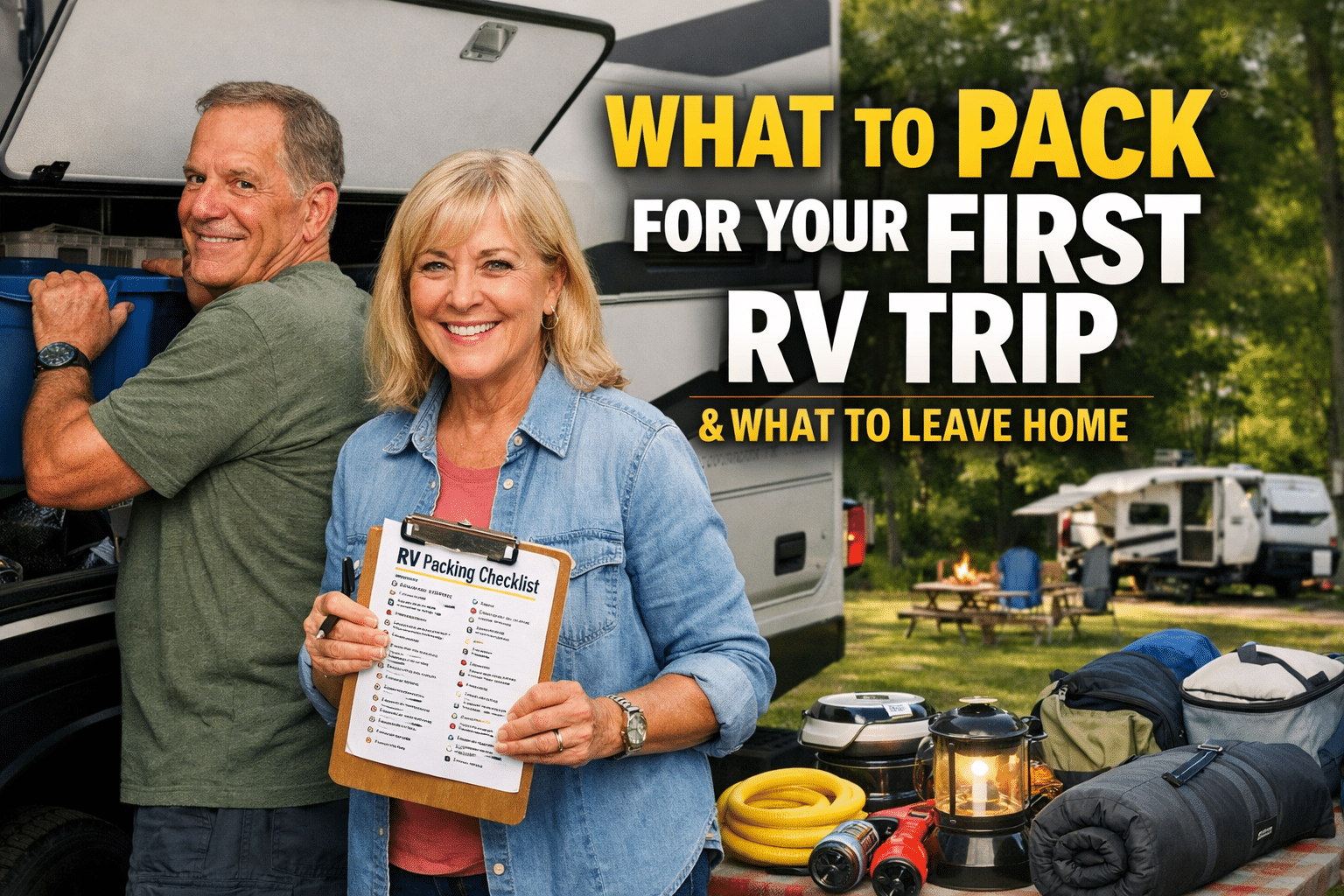
What to Pack for Your First RV Trip, and What to Leave Home
Introduction
One of the most common questions Jennifer and I hear from new RVers is also one of the easiest to overthink:
What should we pack?
We were reminded of that not long ago when we were getting ready for a short trip and Jennifer looked at a growing pile of “maybe” items on the bed and said, “This is exactly how people turn a simple RV trip into a moving day.” She was right. Even after all these years on the road, there is still a temptation to bring too much, just in case. But experience has taught us that the best trips usually start with less clutter, not more.
That is especially true for beginners.
When everything is new, it is natural to want to be prepared for every possibility. You start thinking about weather, meals, gear, campground setup, shoes, jackets, tools, flashlights, extra blankets, backup supplies, and all the things that might go wrong. Before long, many first-time RVers are packing like they are heading into the wilderness for six months instead of taking a short road trip.
The good news is this: your first RV trip does not require perfect packing. It requires smart packing.
That means bringing what you really need, organizing it in a way that makes sense, and leaving enough room to move, breathe, and enjoy the trip. Over the years, Jennifer and I have learned that comfort and simplicity matter much more than quantity. A well-packed RV feels calm. An overpacked RV feels chaotic.
This guide will help you understand what to pack for your first RV trip, what to leave home, and how to think about packing in a way that lowers stress instead of adding to it. If you are brand new to the lifestyle, start with our Start Here page and our Complete Guide to the RV Lifestyle. But if your first trip is coming up and you are staring at a growing pile of gear on the garage floor, this article is for you.
1. Start With the Kind of Trip You Are Actually Taking
One reason beginners overpack is that they pack for imaginary trips instead of the one they are really taking.
If your first RV trip is two or three nights at a full-hookup campground an hour or two from home, you do not need to prepare as if you are crossing Alaska in winter. You need enough to be comfortable, safe, and reasonably self-sufficient for a short getaway.
That is a very different mindset.
Before you pack a single thing, ask a few simple questions. How long is the trip? What will the weather be like? Will you have full hookups? Are you cooking most meals or eating out some of the time? Are you traveling with pets, grandchildren, or just the two of you? The answers help define what actually belongs in the RV.
Jennifer is especially good at grounding this part of the process in reality. She has a way of cutting through the “what if” spiral with one practical question: “Are we actually going to use this on this trip?” That one question can save a lot of cabinet space.
We have seen many first-time RVers fill cabinets with duplicate items, backup items, emergency items, and just-in-case items they never once touch. Then they spend the trip digging through clutter and wondering why the RV feels cramped.
Packing gets much easier when you remember what your first trip is supposed to be: a learning trip.
It is not the final exam of your RV life. It is the beginning.
That is why our article How to Plan Your First RV Trip Without Feeling Overwhelmed matters so much. A simple, close-to-home first trip makes planning easier, driving easier, and packing easier too. And our Your First RV Trip: The Step-by-Step Beginner Checklist helps you think through the whole flow of the trip, not just what goes in the cabinets.
The more realistic you are about the trip you are taking, the less tempted you will be to bring half your house with you.
2. The Personal Basics You Really Do Need
Let us start with the obvious, because sometimes the obvious gets lost in all the RV-specific talk.
For your first trip, you need the same core personal items you would need for any short getaway: clothes, toiletries, medications, chargers, glasses, shoes, weather-appropriate outerwear, and a few comfort items that help you relax.
That may sound too basic to mention, but plenty of first-timers get so focused on hoses, adapters, and leveling blocks that they forget ordinary life still needs to happen on the road.
Pack clothing for the actual forecast, not every season. A couple of casual outfits, layers for cool mornings or evenings, sleepwear, underwear, a rain jacket, and comfortable walking shoes will usually cover a short first trip. You do not need seven backup outfits for a three-night campground stay.
Jennifer has always had a better instinct than I do for what gets used and what just takes up room. Over the years, we have both learned that comfort matters, but excess does not. A favorite sweatshirt, a warm pair of socks, and one good camp chair will add more to your trip than a pile of extra things you never touch.
Toiletries should be simple and familiar. Bring what you normally use, but in manageable amounts if possible. Medications, especially prescriptions, should always be packed first, not as an afterthought. Phone chargers, power cords, and any must-have electronics should be kept somewhere easy to reach.
And then there are the little personal things that make an RV feel like home, your coffee setup, a good blanket, a notebook, maybe a favorite mug. Those small comforts matter more than people realize.
If you are still shaping your overall beginner setup, this is where the RV Lifestyle Travel Planning Center can help. It gives you a place to organize trip notes, packing lists, and practical details. The Trip Planning Dashboard in particular can help you keep all those moving parts together instead of scattered between sticky notes, email confirmations, and your memory.
Pack for everyday life first. Then build from there.
3. Kitchen and Food, Keep It Much Simpler Than You Think
A lot of first-time RVers stock the kitchen as if they are opening a second home.
That usually leads to overstuffed cabinets, too many dishes, too many utensils, too much food, and not nearly enough simplicity. The better strategy is to treat your first RV kitchen like a compact, temporary setup, because that is exactly what it is.
For a short first trip, you do not need every appliance and every pan you own. You need the basics.
Think in terms of easy meals. Coffee supplies. A skillet. A saucepan. A few plates, bowls, cups, and utensils. A cutting board. A can opener. Basic cooking tools. Dish soap. Paper towels. Trash bags. Maybe a small grill if you know you will use it.
And then build your meal plan around simple food.
Breakfasts can be cereal, yogurt, fruit, eggs, or toast. Lunch can be sandwiches or soup. Dinner can be burgers, grilled chicken, pasta, chili, tacos, or something else that does not require a dozen ingredients and an hour of cleanup. Your first trip is not the time to prove your gourmet campground cooking skills.
Jennifer and I have learned over the years that the more complicated the meals, the more complicated the whole trip feels. More ingredients mean more shopping, more storage, more cooking, more dishes, and more mental effort. Simpler meals leave more time for what you actually came for, relaxing, exploring, and enjoying the campground.
One of the smartest first-year habits you can build is planning food with restraint. Bring enough, but not an entire pantry.
This also ties into the bigger beginner topic of cost. Food is one of those areas where RV travel can feel either manageable or surprisingly expensive depending on how you plan. That is one reason our article How Much Does the RV Lifestyle Cost? is so useful for new RVers. It helps you think practically about the real day-to-day expenses of travel.
And if you want a better way to keep track of your trip details, grocery notes, route plans, and daily schedule, the RV Lifestyle Travel Planning Center is built exactly for that kind of organization.
Keep your kitchen small, functional, and easy to manage. You can always add later.
4. The RV Gear You Must Pack for Setup and Campground Life
This is the category that makes beginners the most nervous, because these are the items specific to RVing.
The good news is that the essential list is not endless. It just needs to be thought through carefully.
For most first trips, the must-have RV setup items include your freshwater hose, water pressure regulator, sewer hose, power cord and any needed adapters, leveling blocks if your rig needs them, wheel chocks if appropriate, gloves, and a basic toolkit. You will also want a flashlight, or better yet a couple of them, and a simple storage system for keeping these items organized.
These are the things that help you actually function at the campsite.
That is why our article RV Hookups for Beginners: Water, Electric, and Sewer Made Simple is worth reading before you leave. It explains what these items do and how they fit into campground life so they stop feeling like random equipment and start feeling like a system.
And once you arrive, the smartest thing you can do is follow a routine. That is exactly why we created these two checklists:
Those checklists take a lot of stress out of the process because they help you remember what needs to happen and in what order.
Jennifer and I have seen so many beginners struggle not because they lacked the gear, but because they lacked a routine. They had the hose, but forgot the regulator. They had the setup items, but could not remember where they packed them. They brought the right things, but in a way that made them hard to find at the moment they were needed.
The lesson here is simple: pack RV setup items in a dedicated way. One bin for hookups, one place for power gear, one place for clean-water gear, and one place for tools. Good organization matters as much as the gear itself.
5. What to Leave Home, This Matters More Than You Think
Sometimes the smartest packing decision is what you do not bring.
New RVers often assume the answer to uncertainty is more stuff. More clothes. More kitchen gear. More tools. More backup supplies. More books. More gadgets. More everything. But an RV is not helped by excess. It is burdened by it.
Leave home the duplicates you do not need.
Leave home the bulky “just in case” gear that has no realistic use on a short trip. Leave home the extra outfits for imaginary occasions. Leave home the complicated kitchen equipment you are unlikely to use. Leave home sentimental clutter that adds no comfort and takes up valuable room.
One of the most useful mental shifts in RVing is realizing that stores still exist.
If you forget mustard, socks, foil, batteries, or a spatula, there is a very good chance you can buy it nearby. That does not mean you should be careless. It means you should not pack from a place of fear.
Jennifer and I have both learned that one of the great pleasures of RV travel is the feeling of simplicity. When the rig is organized and uncluttered, the whole trip feels calmer. When every cabinet is jammed and every compartment is overflowing, the RV starts to feel smaller and more stressful than it actually is.
This is also one reason it helps to choose the right RV in the first place. A rig with a floorplan and storage setup that matches how you travel makes packing much easier. If you are still in that stage of the beginner journey, read How to Choose Your First RV Without Making an Expensive Mistake.
Packing well is not about bringing everything. It is about bringing enough, and no more.
6. The Best Way to Organize What You Pack
Packing is only half the job. Organizing what you pack is what determines whether the trip feels smooth or frustrating.
A lot of beginners toss things into cabinets wherever they seem to fit. That works until you arrive and cannot remember where anything is. The flashlight is buried under towels. The coffee filters are behind the paper plates. The hose fittings are loose in a compartment with three unrelated items. The medications are in a bag you cannot quickly find.
That is when packing turns into stress.
The better approach is to group things by use. Personal items together. Kitchen basics together. Hookup gear together. Outdoor setup items together. Emergency basics together. Clean-water items separate from sewer items. Departure-day essentials easy to reach.
If you want a ready-made system for this, take a look at our RV Lifestyle Ultimate Packing List Tool. Jennifer and I created it to help RVers know what to pack, what to skip, and how to stay organized without turning trip prep into a stressful guessing game. It is especially helpful for first-time RVers who want a practical, real-world packing guide instead of trying to reinvent the wheel.
We always recommend that first-year RVers think less like packers and more like systems people. Ask yourself, where will I need this? When will I need this? How quickly will I need to find it?
That kind of thinking changes everything.
It is also exactly why digital organization can be so useful. The RV Lifestyle Travel Planning Center and the Trip Planning Dashboard are helpful not just for routes and reservations, but also for keeping trip notes, checklists, packing reminders, and planning details together in one place.
If you are just entering the RV Lifestyle ecosystem, your best first stop is still Start Here. It helps connect the articles, tools, and next steps in a way that makes the whole learning curve feel more manageable.
A well-organized RV feels bigger, calmer, and easier to enjoy. That is not a small thing on the road.
7. Pack for Confidence, Not Perfection
This may be the most important mindset of all.
Your first RV trip is not the moment you discover the perfect packing list for the rest of your life. It is the moment you begin building it.
That means you are going to learn.
You may bring too many clothes and not enough hangers. You may pack three kitchen tools you never use and forget one item you wish you had. You may realize the flashlight belongs by the door, not in the bedroom drawer. You may discover that your “must-have” extra gear was not necessary at all.
That is normal.
Jennifer and I have been doing this a long time, and even now every new rig, every different trip, and every changing season teaches you something. The best RVers are not the ones who magically got everything right from the beginning. They are the ones who paid attention and kept refining the system.
This is why your first-year content cluster matters so much. Each article helps reduce a different kind of uncertainty:
- Complete Guide to the RV Lifestyle
- How Much Does the RV Lifestyle Cost?
- How to Choose Your First RV Without Making an Expensive Mistake
- How to Plan Your First RV Trip Without Feeling Overwhelmed
- Your First RV Trip: The Step-by-Step Beginner Checklist
- RV Hookups for Beginners: Water, Electric, and Sewer Made Simple
- How to Drive an RV for the First Time With Confidence
- 10 Beginner RV Mistakes That Can Ruin Your First Year on the Road
Packing is part of that larger beginner journey. The goal is not perfection. It is a calmer, more confident first trip, and then a smarter second one.
FAQ: What to Pack for Your First RV Trip
What should first-time RVers pack?
First-time RVers should pack the basics for daily life, clothes, toiletries, medications, simple food, chargers, bedding, towels, and a few comfort items, plus the RV-specific setup gear needed for water, electric, sewer, and campsite setup.
What do most beginners forget to pack for an RV trip?
Many beginners forget practical RV items like a water pressure regulator, flashlight, gloves, power adapters, or a checklist for setup and departure. Others forget everyday basics like medications or coffee supplies.
How much clothing should you pack for your first RV trip?
For a short first trip, pack only what you realistically need for the weather and the number of days you will be gone. Layers and comfortable basics matter more than lots of extra outfits.
Should I stock my RV kitchen like my house?
No. Start with a small, practical kitchen setup and easy meals. Too much kitchen gear creates clutter fast. You can always add more as you learn what you actually use.
What is the best way to organize RV packing?
Group items by use, keep setup gear together, separate clean-water and sewer items, and store frequently needed items where you can reach them easily. Using the RV Lifestyle Travel Planning Center can also help keep notes, lists, and trip details organized.
About the Authors
Mike Wendland is an award-winning journalist and longtime broadcaster who, along with his wife Jennifer, has spent more than 15 years traveling North America by RV. Together, they are the founders of RVLifestyle.com, the RV Podcast, and the RV Lifestyle Community, where they share trusted advice on RV travel, trip planning, gear, campgrounds, and the realities of life on the road. Their mission is to help RVers, especially beginners, travel with more confidence, clarity, and joy.
More RV Lifestyle Resources to Help You Succeed on the Road
If this guide has sparked your interest in the RV lifestyle, we have created a full ecosystem of resources to help you learn faster, travel smarter, and connect with other RVers who share your passion for the open road.
RV Lifestyle Travel Guides: Expert Pre-Planned RV Trips
Our detailed RV travel guides take the guesswork out of trip planning. Each guide includes scenic routes, must-see attractions, handpicked campgrounds, and daily driving plans designed specifically for RV travelers.
Explore them here:
https://shop.rvlifestyle.com
RV Lifestyle Community: A Friendly Private Community for RVers
Join thousands of RVers in our private online community where you can ask questions, share experiences, get fast answers from experienced travelers, and participate in member-only events, livestreams, and rallies.
Learn more here:
https://rvcommunity.com
The RV Podcast: Weekly RV News, Tips, and Travel Stories
Our weekly RV Podcast features practical advice, industry news, campground discoveries, and inspiring stories from fellow RV travelers.
Listen here:
https://rvpodcast.com
RV Lifestyle YouTube Channel: RV Tours, Travel Tips, and Adventures
Watch RV tours, campground reviews, travel adventures, and practical how-to videos from Mike and Jen as they explore North America by RV.
Watch here:
https://youtube.com/@RVLifestyle
RV Lifestyle Masterclass: Learn Everything About RV Living
Our step-by-step RV Lifestyle Masterclass teaches everything you need to know about choosing an RV, traveling confidently, maintaining your rig, saving money on the road, and building the RV lifestyle you dream about.
Learn more here:
https://rvlifestyle.com/masterclass
Packing for your first RV trip should make you feel more prepared, not more overwhelmed. Keep it simple, pack for the trip you are actually taking, organize what matters, and let the first outing teach you what your personal system needs. That is how real confidence grows on the road.
Be sure to explore these resources and continue learning, traveling, connecting, and growing with us.
Happy Trails!
Life’s Best Chapter Starts Here
in the RV Community

You’ve raised the kids. Done the 9-to-5. Now it’s your time.
Join a private, ad-free community built just for RVers who crave connection, adventure, and meaningful conversation.
- In-person meetups & rallies
- Twice a week member only livestreams and Virtual Campfires that are pure fun
- Exclusive courses on mastering the RV lifestyle
- Real people. No drama. No ads.
- Special interest spaces for more than two dozen RV subjects
Because the open road is better with friends. Check it out here https://RVCommunity.com

