
Sweet History: Exploring Louisiana’s Sugar Cane Legacy
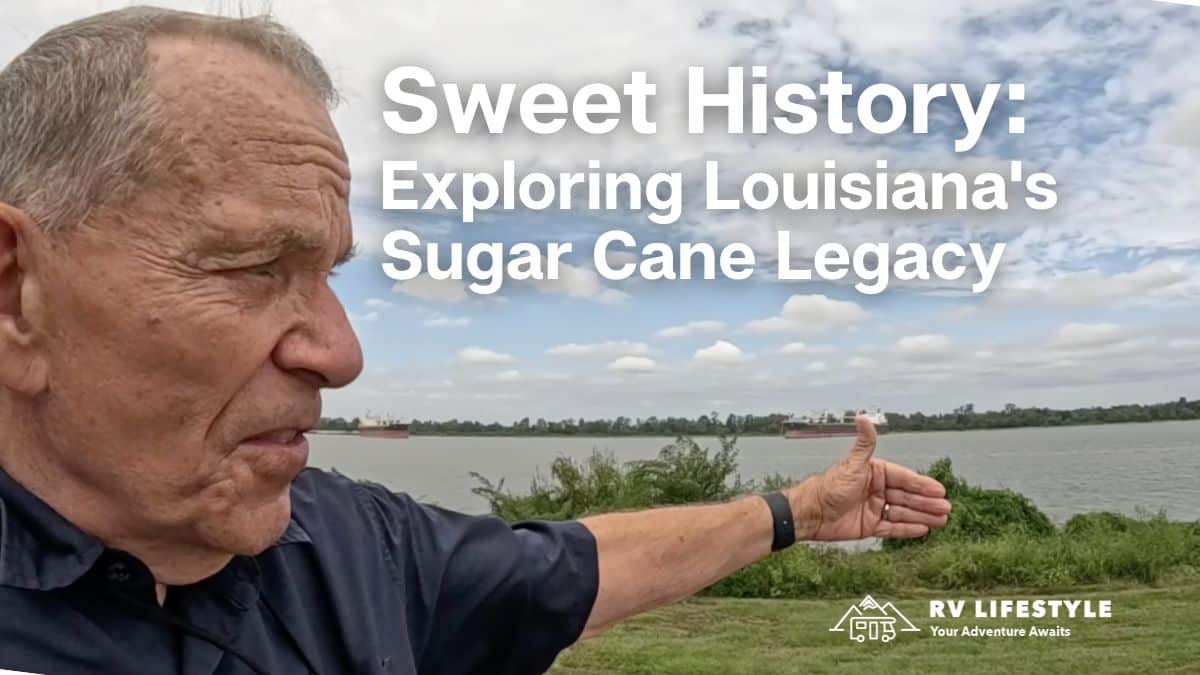
On this leg of our Fantasy RV Tour of the Mississippi, we stepped back in time – way back – visiting two incredible sugar cane plantations nestled along the river between Baton Rouge and New Orleans.
The Laura Plantation and Oak Alley gave us a fascinating glimpse into Louisiana's complex past, and honestly, we came away with a much deeper understanding of how the mighty Mississippi shaped everything about this region.
The Land That Sugar Cane Built
Driving along the River Road, you can't help but notice how lush and fertile everything looks. There's a reason for that – the Mississippi River has been flooding these banks for thousands of years, each time leaving behind another layer of nutrient-rich sediment. It's like the river has been preparing the perfect recipe for agriculture, depositing silt, minerals, and organic matter to create some of the most productive soil in North America.

This “black gold,” as some call it, became the foundation for Louisiana's sugar cane empire. Sugar cane is a thirsty, demanding crop that needs both abundant water and incredibly rich soil to thrive. The Mississippi delivered both, making this narrow stretch of land between Baton Rouge and New Orleans absolute prime real estate in the 18th and 19th centuries. At the industry's peak, there were hundreds of sugar plantations lining this corridor – some estimates put it at over 500 plantations. Today, you can still see remnants of that era dotting the landscape.
Laura Plantation: Stories in Creole
Our first stop was the Laura Plantation, and right away, it felt different from what we expected. This isn't your typical Gone with the Wind fantasy. Laura is all about authenticity, focusing on the Creole culture that made Louisiana so unique.

The plantation was named after Laura Locoul, who grew up there and left behind memoirs that give us an incredibly rare first-person account of plantation life. What struck Jen and me the most was learning about Louisiana's Creole culture – that fascinating blend of French, Spanish, African, and Native American influences that you don't find anywhere else in quite the same way.
The guides here don't shy away from the difficult truths. They talk openly about the enslaved people who made this plantation profitable, sharing their stories, their living conditions, and their contributions to Creole culture. In fact, Laura Plantation is where scholars discovered the origins of the Br'er Rabbit folk tales, brought here by enslaved people from Senegal. Walking through the reconstructed slave quarters – simple one-room wooden cabins that housed entire families – really brings home the human cost of all that sugar wealth.
The main house itself is painted in vibrant Creole colors (not the white columns you might expect), and the whole experience feels more honest, more real, than some other plantation tours we've heard about.
I have to share a story that brought this home to us.
When Laura was a young child playing near the well one afternoon, an elderly enslaved man named Felippe approached to draw water for the mules. As he bent over the bucket, sunlight caught strange markings on his weathered cheeks—letters scarred into his dark skin. With a child's innocent curiosity, Laura asked what they were, and Felippe quietly explained that he had been branded decades earlier as punishment for attempting to escape when he was barely more than a boy.
The revelation struck Laura with terrible force, shattering the comfortable illusions of her sheltered plantation childhood. Though she had grown up surrounded by enslaved people and even played with enslaved children as companions, she had never before confronted the raw brutality that underpinned the entire system.
The horror deepened when she later learned that her own grandmother – the stern matriarch she knew so well – had overseen the branding when fifteen-year-old Felippe had dared to run toward freedom.
Those scars on Felippe's face became an indelible mark on Laura's own consciousness, a permanent reminder that the genteel world of her Creole upbringing rested upon unthinkable cruelty, and that her own family had wielded the instruments of that violence against a desperate child seeking liberty.
Laura ran the plantation for about 10 years after her father died in 1879, but hated every minute of it. No doubt the story of Felipe played a major role in her interest in plantation life. She sold it and left Louisiana in 1892,
Laura lived to be 101 years old, and in 1936, at age 74, she wrote her memoir “Memories of the Old Plantation Home,” which has become the basis for tours at the plantation today.
Oak Alley: The Grand Dame
After the Laura Plantation, we moved a few miles down the road and headed to Oak Alley, and wow—talk about making an entrance! That quarter-mile canopy of 28 massive live oak trees, planted in the early 1700s, creates a tunnel of greenery that takes your breath away. These trees predate the plantation house itself, and they've become one of the most photographed sights in the South.
A whole bunch of movies have been filmed here, with these Live Oaks as a backdrop: Ghost Hunters, Interview With a Vampire, Primary Colors, Beyoncé's “Déjà Vu” Music Video, Hush, Sweet Charlotte, The Long, Hot Summer, and others.

The Greek Revival mansion, built in the 1830s, is certainly impressive with its symmetrical galleries and perfect proportions. But again, what really got to us was learning about the 220 enslaved people who lived and labored here at the plantation's peak. Oak Alley has made significant efforts in recent years to tell their stories through exhibits and a dedicated memorial.
Walking the grounds, you can see the remains of the sugar operation—where the cane was processed, where molasses was made, where the backbreaking work happened from sunup to sundown, especially during grinding season when the mills ran 24 hours a day.
The Mississippi: Making It All Possible
Here's the thing that really connected for Jen and me today: none of this would have existed without the Mississippi River. And I mean that literally.
First, there's the soil. Every time the river flooded (which it did regularly before modern levee systems), it deposited another layer of sediment. Over millennia, this created soil up to 100 feet deep in some places—absurdly fertile and perfect for sugar cane's deep root system.
Second, there's irrigation. Sugar cane needs consistent moisture, and the river's proximity meant water was always accessible, either directly or through the high water table.
Third, there's transportation. In the 1800s, the Mississippi was the superhighway. Sugar and molasses could be loaded onto riverboats and shipped to New Orleans, then on to markets across America and the world. Without this water route, these plantations would have been economically impossible—there was no way to get such a heavy, bulky product to market otherwise.
Even today, the importance of that waterway is as evident as climbing the levee right across the road from Oak Alley. I counted no less than four ocean-going ships docked along the opposite bank of the river, ready for cargo they would haul around the world.

The True Cost of Sweetness
Standing on the edge of those plantation fields today, surrounded by descendants of those original cane crops, it's impossible not to think about the human cost behind every pound of sugar. The wealth built here – and there was staggering wealth – came directly from enslaved labor. People were bought, sold, separated from families, worked to exhaustion, and denied their humanity so that European and American tables could have sugar in their coffee and rum in their glasses.
Harvesting cane back then was brutal. The machetes wielded against the tough cane stalks often missed, resulting in amputations – the most common type of injury for enslaved workers, according to our guide. And those cane leaves can be dangerous. The edges are like serrated knives. Sugar cane leaves have tiny, microscopic silica crystals embedded along their edges, creating a naturally serrated, saw-like surface. These aren't smooth cuts – they're more like being sliced by a rough-edged blade.. In fact, as I took the photo below, the wind whipped one of the long leaves across my camera lens. I grabbed hold of it to move it aside, and it almost broke my skin, like a paper cut..
Our guide also said there were lots of venomous snakes in those fields. In those Louisiana fields, attracted by the rodents drawn there to gnaw on the cane, are cottonmouths, copperheads, and canebrake rattlesnakes, a species that can grow surprisingly large.
Field workers in cane-growing regions typically wear heavy boots and protective clothing, and snakebite is a recognized occupational hazard in the sugar industry worldwide. Back before modern medicine, a bite could be deadly.

The Creole culture that developed in this area was both beautiful and tragic—a blending of traditions born partly from cultural exchange and partly from oppression. The food, music, language, and customs that make Louisiana so special today have roots in both the resilience of enslaved peoples and the complex social hierarchies of plantation society.
Reflections from the Road
As we headed back to our RV campground, we found ourselves pretty quiet, processing everything we'd seen and learned. The Mississippi River, which we've been following and marveling at throughout this journey, revealed another side of itself today. It's not just a natural wonder or an engineering challenge – it's been a force that shaped human history, for better and worse.
Those fertile soils that made fortunes possible also tied countless human lives to brutal labor. The same floods that enriched the earth also made this region vulnerable. And that mighty river that connected plantations to global markets also carried enslaved people away from their homeland and deeper into bondage.
There's something powerful about standing on ground where so much history – beautiful and terrible – unfolded, all because a river decided to flood and deposit its gifts along these particular banks.
If you're ever traveling this route, make time for these plantations. Yes, the oak trees are gorgeous and the architecture is impressive, but the real value is in the stories- the complex, uncomfortable, essential stories of how the Mississippi River, sugar cane, and human ambition combined to create a world that still echoes through Louisiana today.
Catch up on The Great River Road series:
- The Great River Road: An Inauspicious Start to An Epic RV Adventure
- Along the Great River Road – to the Twin Cities
- The Amana Colonies: From Commune to Tourist Attraction
- Hannibal, MO: Mark Twain, Tom Sawyer and the River
- RV Tour Uncovers the Horrors of History: Vicksburg and Natchez, MS
- Wandering the Waterways: A Bayou Adventure Outside New Orleans
Life’s Best Chapter Starts Here
in the RV Community

You’ve raised the kids. Done the 9-to-5. Now it’s your time.
Join a private, ad-free community built just for RVers who crave connection, adventure, and meaningful conversation.
- In-person meetups & rallies
- Twice a week member only livestreams and Virtual Campfires that are pure fun
- Exclusive courses on mastering the RV lifestyle
- Real people. No drama. No ads.
- Special interest spaces for more than two dozen RV subjects
Because the open road is better with friends. Check it out here https://RVCommunity.com

