
St. Louis: Where the River Meets the Arch
The halfway point of our Fantasy RV Tour of the Mississippi River finds us in St. Louis, where our days begin early with a 7:45 AM bus departure, and tours keep us occupied until well after 5 PM when we finally return to the campground.
Although we occasionally get what's technically called a “free day,” the reality is that this so-called free time quickly disappears into the necessities of travel life: shopping for groceries, tending to essential errands (I desperately need a haircut!), doing laundry, and simply catching our breath from the whirlwind of activity.

St. Louis holds a unique place in American history as the Gateway to the West. The city's strategic location at the confluence of the Mississippi and Missouri Rivers made it a natural crossroads for centuries. The Mississippi is the nation's largest. Missouri is the longest.
They connect about 10 miles north of St. Louis at the site of the Missouri Confluence State Park, where the above photo was taken. It shows the exact spot of the convergence. The Missouri carries more sediment (that's why it's called the “Big Muddy”) as evidenced when it meets the clearer Mississippi.
A Little History of St. Louis
Long before European explorers arrived, Native American peoples recognized the importance of this meeting point. It formed a powerful corridor that shaped the expansion and commerce of a growing nation.
French fur traders founded St. Louis in 1764, naming it after King Louis IX of France. The settlement quickly became a vital trading post, serving as the last major supply point for expeditions heading west. When Meriwether Lewis and William Clark launched their famous expedition in 1804, they departed from the St. Louis area, cementing the city's role as the launching pad for westward exploration.
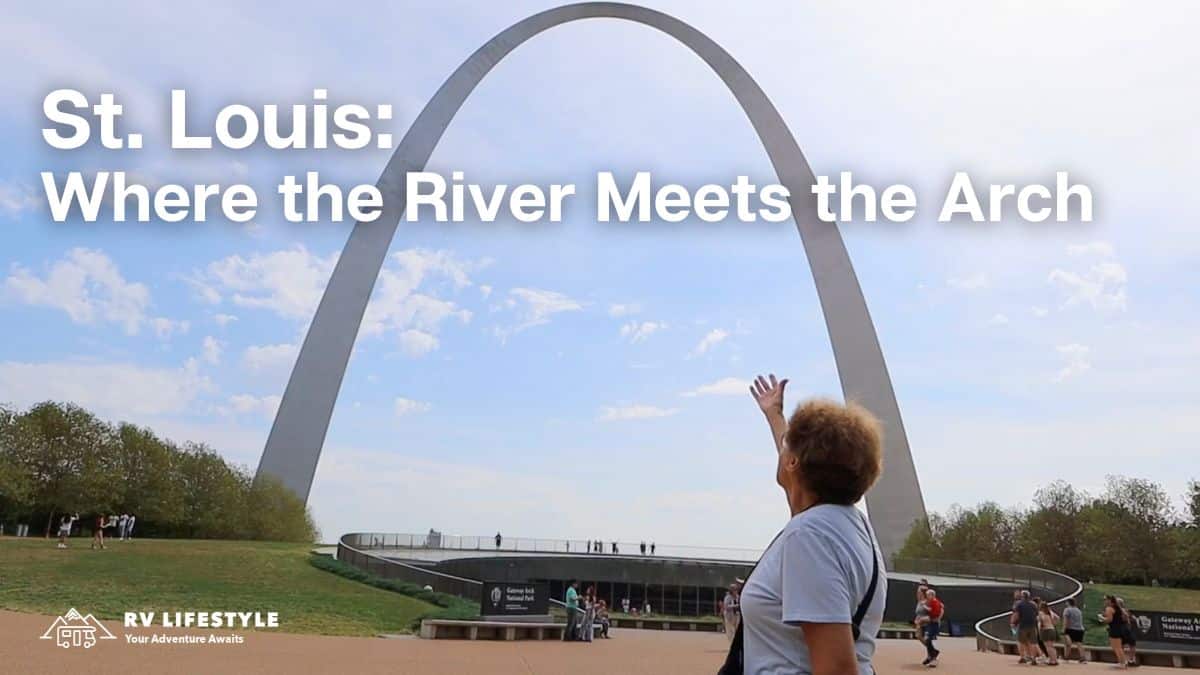
Downtown, we spent several hours at the fabled St. Louis Gateway Arch. Did you know that, since 2018, the arch has been designated a National Park?

St. Louis Gateway Arch
The Gateway Arch, St. Louis's most iconic landmark, was built between 1963 and 1965 to commemorate this pivotal role in westward expansion. Designed by architect Eero Saarinen, the 630-foot stainless steel monument stands as the tallest man-made monument in the United States.
Its graceful catenary curve rises from the banks of the Mississippi River, visible for miles in every direction. The Arch isn't merely a symbol; it's a tribute to the pioneers, fur traders, explorers, and settlers who passed through St. Louis on their way to new territories, and to the indigenous peoples whose lands these were.
The confluence of the two great rivers continues to define St. Louis's character.
The Mississippi-Missouri river system forms the fourth-longest river system in the world, and their meeting point has been crucial for transportation, trade, and economic development for over two centuries. Barges still ply these waters daily, carrying grain, coal, and manufactured goods, much as steamboats once did in the 19th century. Standing beneath the Arch or viewing the rivers from nearby parks, you can't help but feel the weight of history and the power of these waterways that literally shaped the course of American expansion.
It is genuinely an amazing engineering marvel, as evidenced in a surprisingly entertaining movie shown by the National Park Service on how it was constructed. A museum below the arch shows how the two rivers shaped the city that was the starting point to western expansion.
Outside of town, we toured the Great Rivers Museum, learning about the system of 29 lock and dams that keep the river deep enough to float the barge traffic (it must have a channel at least 9 feet deep).
We ended the day with a tour of the sprawling Anheuser-Busch complex, where Budweiser, Busch, Michelob, and numerous other brands owned by the company are brewed and bottled. Yes, they had free beer. Though Jennifer came for the famed Clydesdales.
These magnificent horses were first introduced to the public on April 7, 1933, to celebrate the repeal of Prohibition, when August A. Busch Jr. presented them, pulling a red, white, and gold beer wagon, to his father, August A. Busch Sr., outside the brewery.
These aren't your average horses. To qualify for one of the hitches, a Budweiser Clydesdale must be a gelding with an even temperament, be at least four years old, stand at least 18 hands (72 inches) at the withers when fully mature, and weigh between 1,800 and 2,300 pounds. That's over six feet tall at the shoulder!

Here's a video on our YouTube Channel, showing some of the highlights from St Louis.
In the meantime, the bus leaves this morning at 8 AM and I have to walk Bo before we leave.
If you're wondering what we do with Bo as we tour, he has to stay back in the air-conditioned RV. Fantasy has helped us line up dog walkers, and Bo has a great one who will come by to give him lunch and take him for a walk around noon. We've been doing that regularly on the days we have to be on a bus.
Catch up on The Great River Road series:
- The Great River Road: An Inauspicious Start to An Epic RV Adventure
- Along the Great River Road – to the Twin Cities
- The Amana Colonies: From Commune to Tourist Attraction
- Hannibal, MO: Mark Twain, Tom Sawyer and the River
Life’s Best Chapter Starts Here
in the RV Community

You’ve raised the kids. Done the 9-to-5. Now it’s your time.
Join a private, ad-free community built just for RVers who crave connection, adventure, and meaningful conversation.
- In-person meetups & rallies
- Twice a week member only livestreams and Virtual Campfires that are pure fun
- Exclusive courses on mastering the RV lifestyle
- Real people. No drama. No ads.
- Special interest spaces for more than two dozen RV subjects
Because the open road is better with friends. Check it out here https://RVCommunity.com


Can you recommend a campground near the Arch, and is there RV parking at the Arch ?
Thanks !